“I see the student has become the master” – Sensei Wu, Ninjago
Today I was asked to tutor a friend of my sister’s. The kid, who is 14, sent me a message asking if I could help with computer science homework, and I was more than happy to agree.
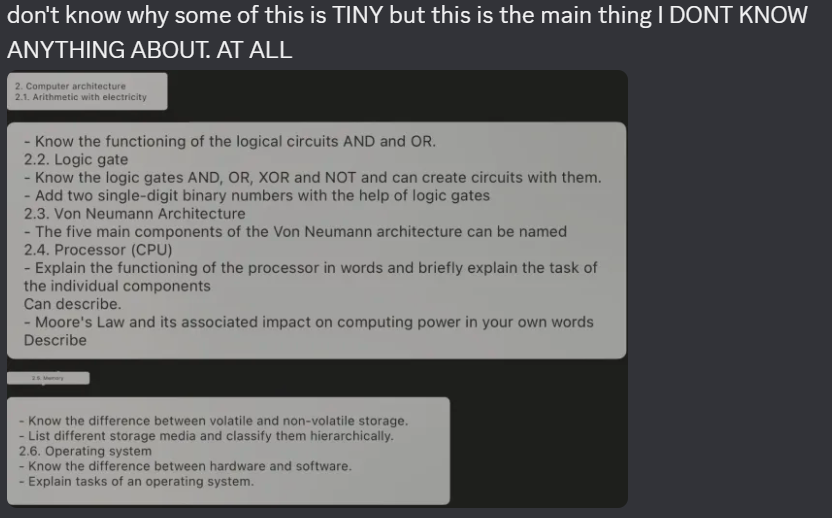
I was sent a list of questions(seen in Figure 1) that he would have to answer in a test. I was surprised to find that most of it was actually related to hardware and circuitry. The main part he needed help with was understanding logic gates, from the way he explained them it sounded like he was really struggling, poor kid.
I felt very luck as even though I didn’t know what a logic gate was myself, after a quick search I understood them quite easily. They’re basically types of booleans, and when in a circuit they’re most often made of MOSFET transistors. They’re very simple when you understand what the words mean, but I can see where someone would get confused or overwhelmed. After explaining booleans to the kid, I broke down how the names of the different types of logic gates work.
Basically, they’re named similarly to how they’d be coded, for example two different gates are AND(&&) and OR(||). I can imagine getting confused at NAND if it wasn’t explained that names are abbreviated. NAND is actually NOT AND(!&).
I explained these to the kid and tried to simplify it enough so that he would understand them(using fruit as true math problems would), and he was very pleased with it. I hope he does well on his test, I’ll have to ask for his results.