Author: admin

  • Year 3 Week 6 – 02/11/26

    “I see the student has become the master” – Sensei Wu, Ninjago

    Today I was asked to tutor a friend of my sister’s. The kid, who is 14, sent me a message asking if I could help with computer science homework, and I was more than happy to agree.

    I was sent a list of questions(seen in Figure 1) that he would have to answer in a test. I was surprised to find that most of it was actually related to hardware and circuitry. The main part he needed help with was understanding logic gates, from the way he explained them it sounded like he was really struggling, poor kid.

    I felt very luck as even though I didn’t know what a logic gate was myself, after a quick search I understood them quite easily. They’re basically types of booleans, and when in a circuit they’re most often made of MOSFET transistors. They’re very simple when you understand what the words mean, but I can see where someone would get confused or overwhelmed. After explaining booleans to the kid, I broke down how the names of the different types of logic gates work.

    Basically, they’re named similarly to how they’d be coded, for example two different gates are AND(&&) and OR(||). I can imagine getting confused at NAND if it wasn’t explained that names are abbreviated. NAND is actually NOT AND(!&).

    I explained these to the kid and tried to simplify it enough so that he would understand them(using fruit as true math problems would), and he was very pleased with it. I hope he does well on his test, I’ll have to ask for his results.
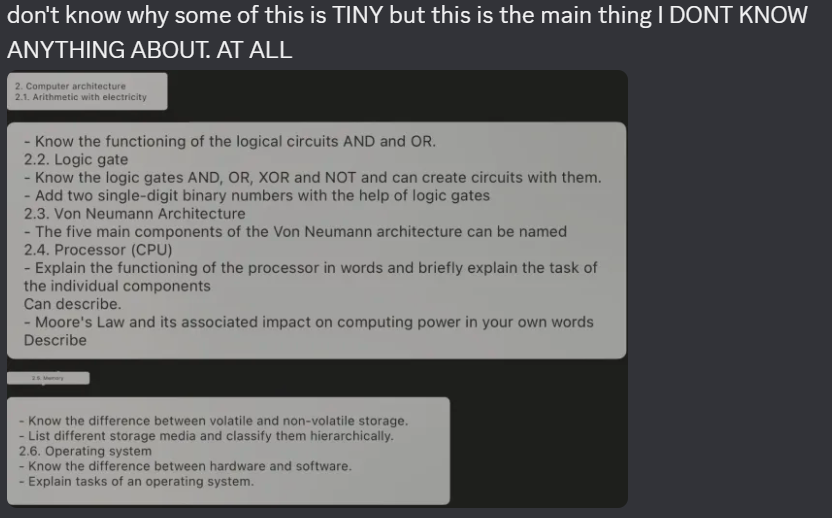
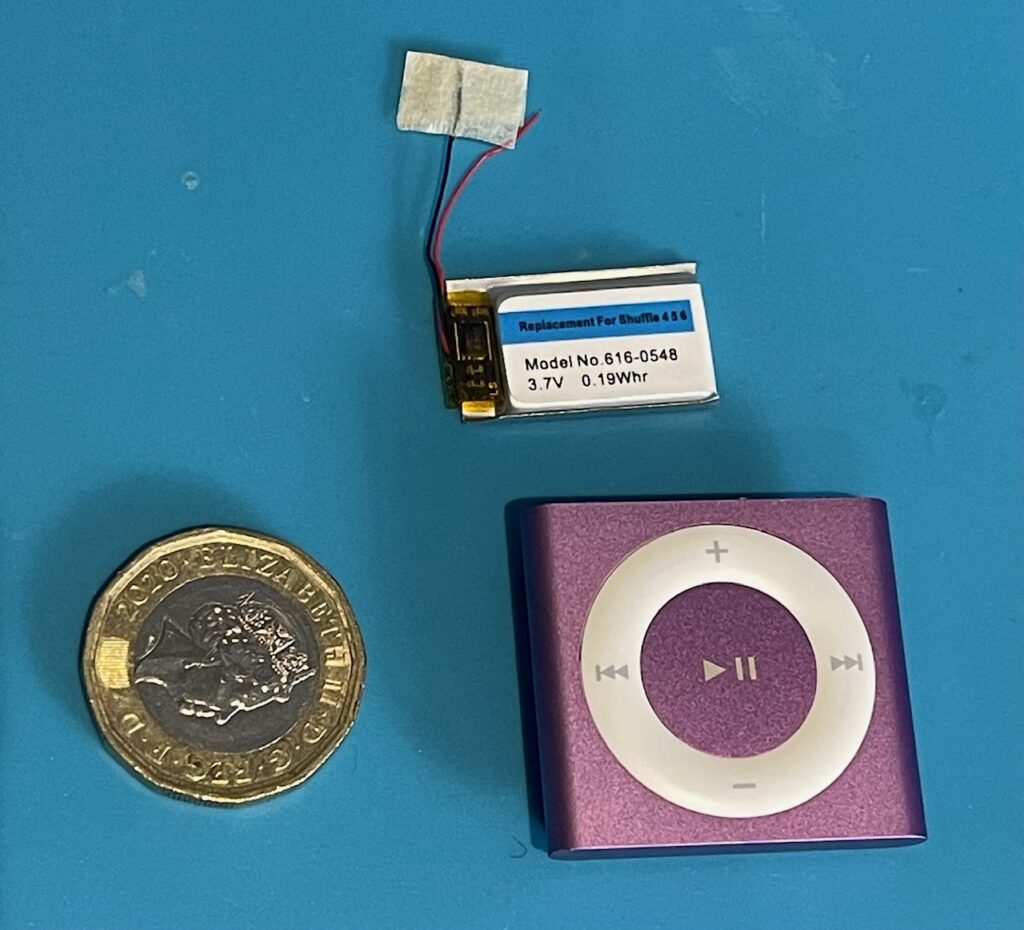
    Figure 1: Computer Science Homework that belongs to my sister’s friend, age 14. I got permission to include this image from him
  • Year 3 Week 5 – 26/10/26

    “When hearts are high, the time will fly! So whistle while you work” – Snow White and the Seven Dwarfs

    As much as I was enjoying my work at the Tesco’s Phone Shop, it wasn’t for me. The commute was very long, and it did not line up with my university hours well. I was contracted for 20 hours a week, but my commute was making it closer to 35, and the two days off I had a week weren’t next to each other so I had no weekend.

    I was panicking when I received another interview offer from CeX, a place I’ve wanted to work for years. I scheduled a call with Luke again and he helped me make a game plan based off what my needs were. We decided I would keep working at Tesco until my CeX interview, then after my interview I’d decide whether I’d want to stay at Tesco or quit. If I chose to stay Luke would’ve helped me negotiate shorter hours on different days, but the CeX interview went so well so I chose the latter.

    Luke helped me draft a formal resignation letter, I didn’t have to give notice due to only having worked for 3 weeks, and I am now a CeX sales assistant. The job is so fun, I’ve learned so much about the legalities of selling technology in the uk already!

    I am very happy with the new job. It will look great on my cv as it is related to technology, and I can already tell I’m going to learn a lot from it.

  • Year 3 Week 4 – 19/10/26

    “Keep moving forward!” – Wilbur Robinson, Meet The Robinsons

    One of the first things I learned to repair was iPods. I really hate Spotify, they underplay artists and incorporate generative AI into their platform, so when I learned people were digging up old iPods and fixing them I immediately hopped onto the trend.

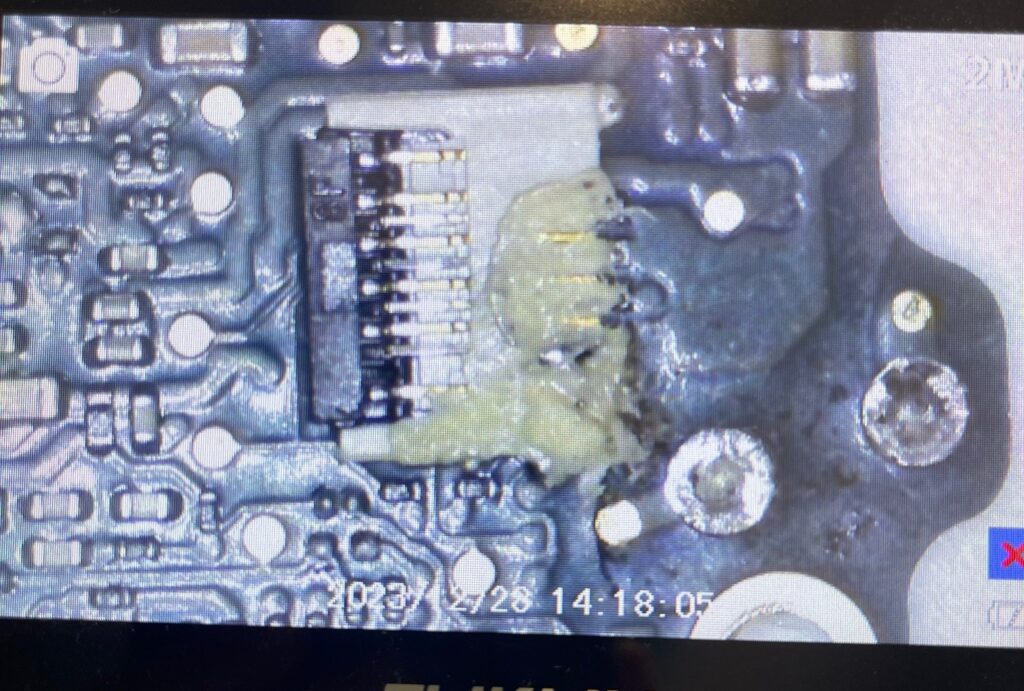
    My friend Ava asked me if I would fix her old 4th gen iPod shuffle yesterday, seen in Fig. 1, and I happily agreed to do so. This made me reflect on the first iPod I fixed as it was also a 4th gen. Companies such as Apple often use parts that are easy to break, such as screws made of weak metals that strip easily, to deter people from fixing them at home. With the 4th gen shuffles I found that as soon as I tried to solder in a new battery the ribbon cable housing melted (seen in Fig. 3)! It had only been a few seconds but the board was ruined instantly. I am much more careful nowadays, using a lower temperature on my iron and kapton tape to protect the plastic.

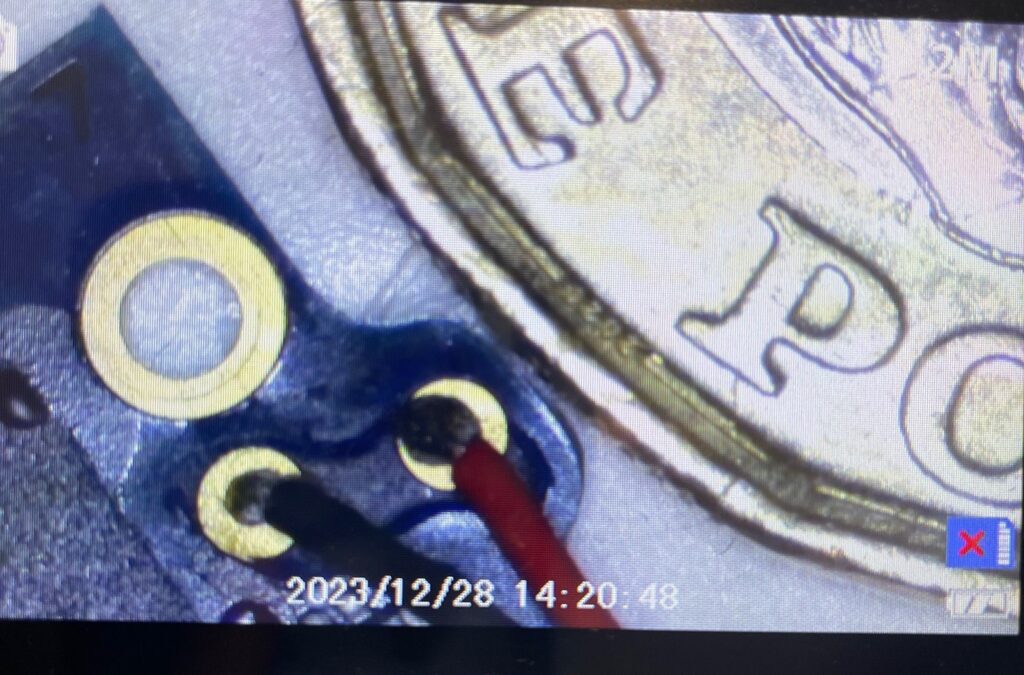
    The batteries use through-hole soldering, which makes it even more difficult to replace them. I often get a friend to hold the board for me while I do it, and I need a microscope to see where the holes are. As seen in Fig. 2, they are extremely small.

    Ava’s iPod is working perfectly with the new battery and I’ll give it to her in Thursday!

    Figure 1: Ava’s 4th Gen iPod Shuffle and replacvement battery with a pound coin for scale
    Figure 2: iPod battery solder points next to pound coin for scale
    Figure 3: iPod 4th gen shuffle board I Melted with a soldering iron
  • Year 3 Week 3 – 12/10/26

    “Ooooooh, money money money!” – Andy, Toy Story

    In the later half of the summer I realised I wanted to get a part-time job. I had supported myself previously through earnings I made off of a YouTube channel, but that had started affecting my mental health and I chose to quit. University has really helped me figure out who I am and what I want to be, I am so much happier than I was at the beginning and this is another step towards that.

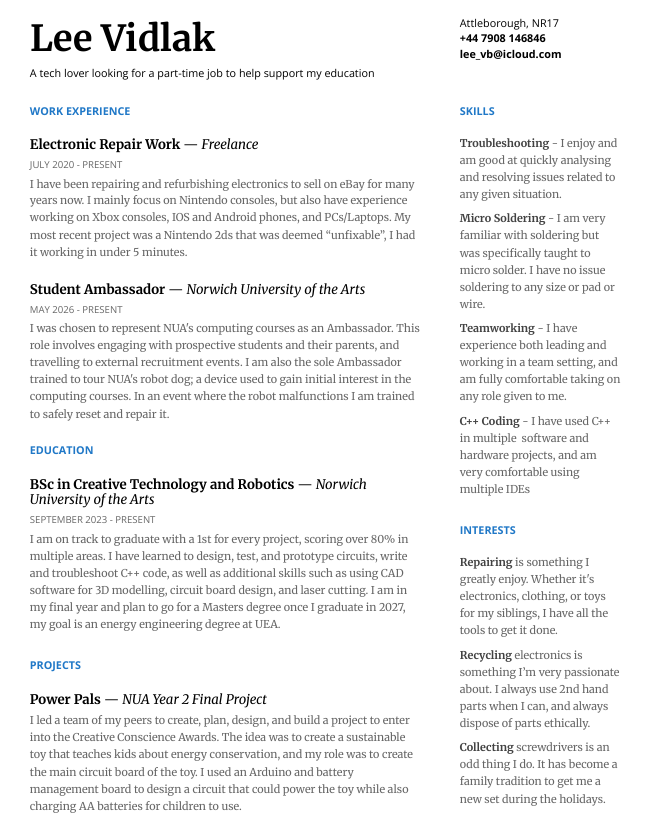
    I wrote out a draft CV using what I remembered from our previous careers classes, and then asked Luke if we could schedule a 1-1 to go over it. He gave me such great advice and helped me finetune my CV into something that looks really impressive, as seen in Figure 2.

    Luke advised me to go for jobs in the tech industry. His reasoning was that most retail jobs will be very competitive due to pretty much all new students also applying for them. Whereas something like a repair job requires skills not everyone has, meaning I have a higher likelihood of getting them.

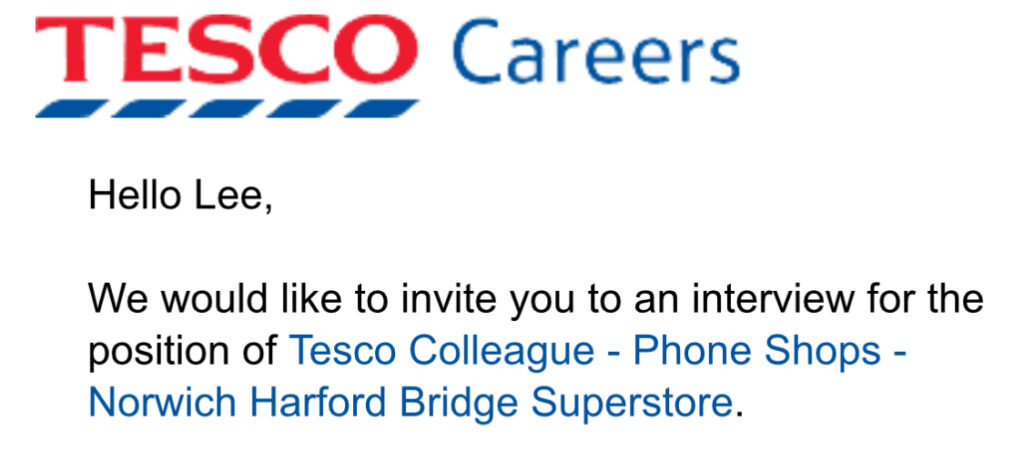
    My routine became getting up early and refreshing Linkedin throughout the day, and that led me to landing an interview within the week! I was very scared for the interview, but Luke very kindly hopped on another teams call with me and talked me through it. And it went well! I got along great with the interviewer and landed the job, making me the latest technician at a Tesco Phone Shop (Figure 1)!

    Figure 1: Tesco Interview invite
    Figure 2: My Final CV (Link to PDF Version: HERE)
  • Year 3 Week 2 – 05/10/26

    “No, no more running. It’s time to change things up” – Lloyd Garmadon, Ninjago

    I’ve mentioned it before, but I have always hated group projects. Looking back I think it’s due to a lack of control. The collaborative project I worked on in Year 2 was great, and I ended up making something I’m extremely proud of. This year I’ve already had 2 small group tasks, and I think I’m starting to change my mind on the idea.

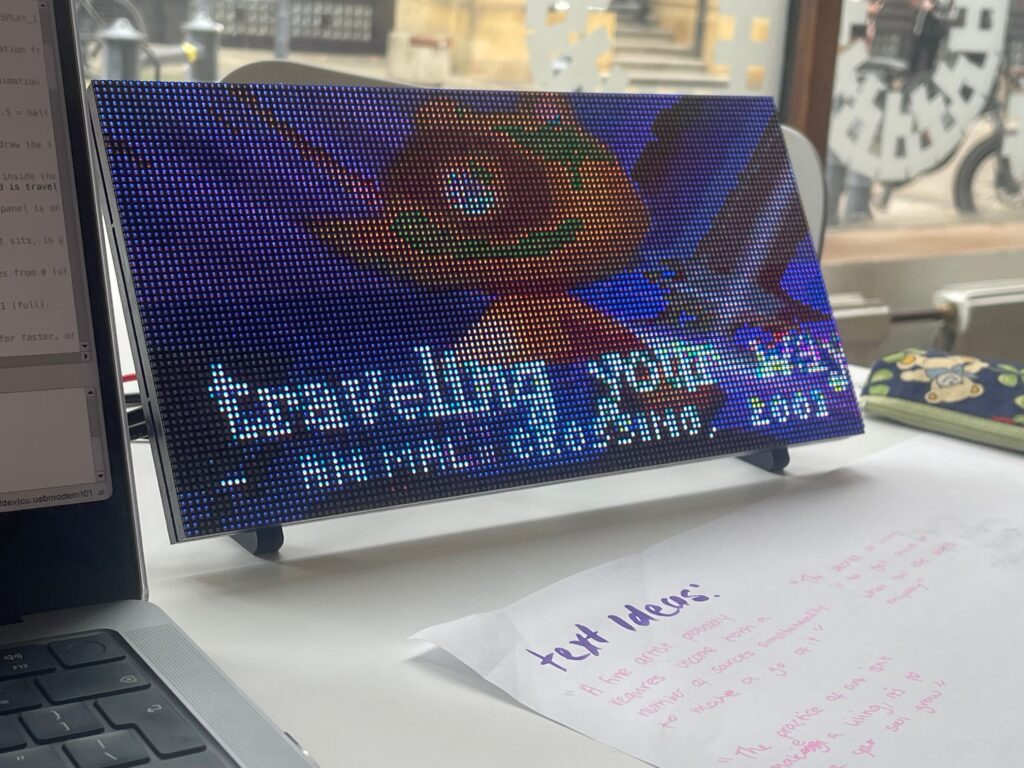
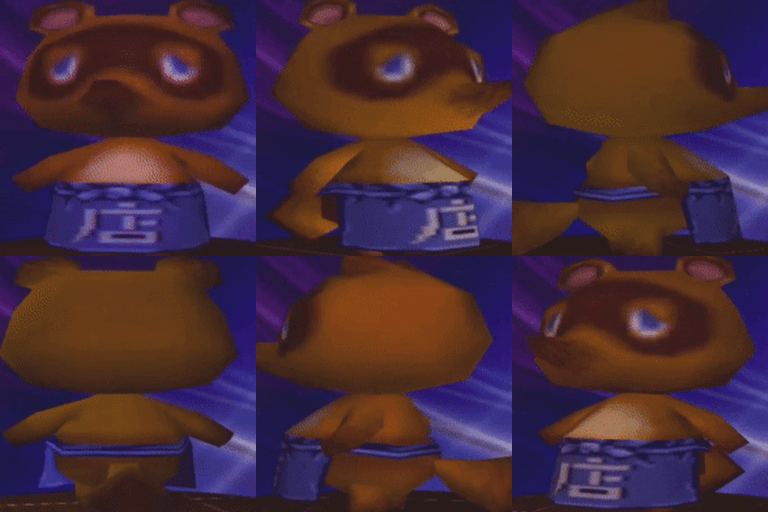
    The make-it manifesto, something I’ve hated since I was in games, was so fun. This year I paired up with Ava to display inspirational art on an LED display, seen in Figures 1 and 2. When asked what inspires us to work hard we both jokingly said “money”, but then after talking it over we decided that that can be a motivator, and it doesn’t have to be a selfish or negative thing. We both love the game Animal Crossing, and that game has a very beautiful quote about earning money when working hard for yourself. We decided to use that to hopefully inspire some students who come across it.

    “Oh, my child! All the money in the world is traveling your way. Won’t that be nice? Of course, that may not be what is to happen… After all, there is no such thing as easy money. But for now, you may reap large rewards if you work just a little bit.” – Katrina, Animal Crossing

    After the Manifesto we had our first Masterclass. It focused on Bluetooth, and was a lot of fun. I did not plan on working with anyone, but Lara asked to work together and I didn’t want to say “no”. We chose to use the speaker component as I had fun using the buzzer on the Pololu’s last year and wanted to explore that further. In the end we could play a scale of notes from our phones via Bluetooth. I actually had a lot of fun with it, and I think she did too. Last year she seemed a bit less enthusiastic, so I’m glad she’s become confident enough to ask to work together!

    I’d actually consider pairing up with someone for the final project. It depends what my friends want to do, and I will not work with someone I’m not close with, but that’s such a step up from my view of teamwork from last year.

    Figure 1: Final Make-it Manifesto Piece
    Figure 2: Tom Nook Gif
  • Year 3 Week 1 – 28/09/26

    “There’s 104 days of summer vacation, and school comes along just to end it” – Phineas and Ferb

    I was worried that my summer was an unproductive one, but after reflecting on it I have changed my mind.

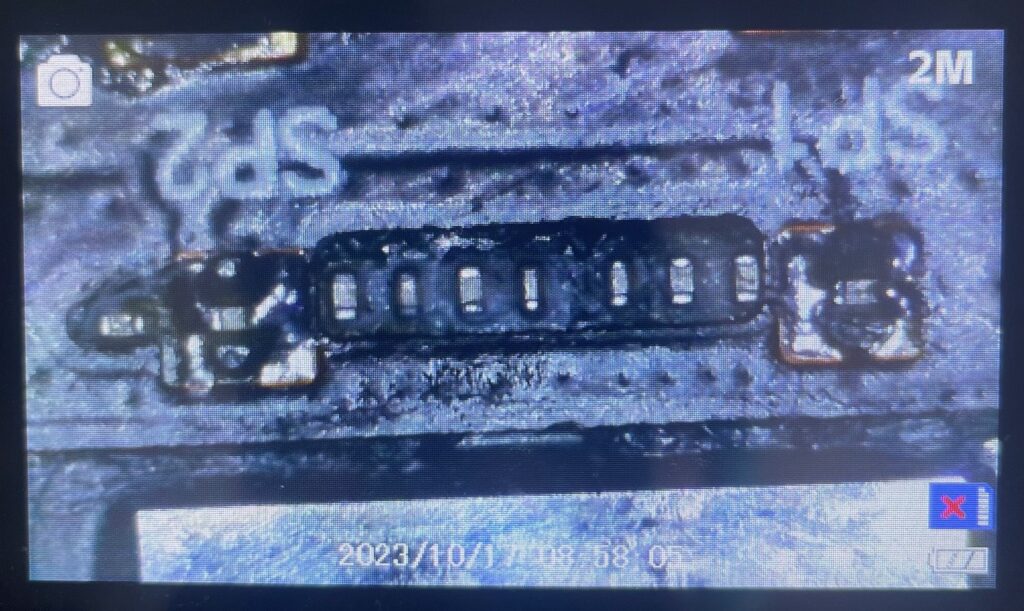
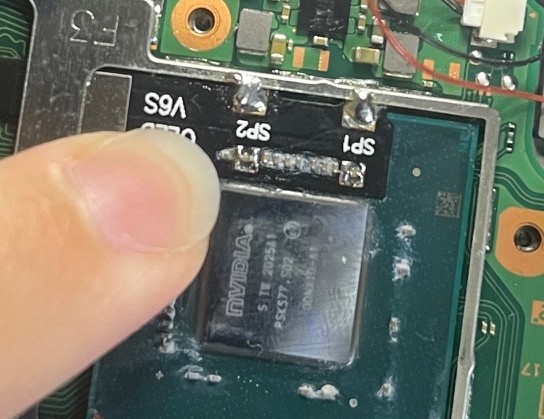
    I have greatly improved my soldering skills. I wanted to learn how modchips are installed, and it takes microsoldering to a whole new level. The pads were genuinely the size of a crumb, as seen in Figures 1 and 2, I could not see them without a microscope. I got stuck for weeks, being unable to get the solder to flow, and ended up doing a lot of research into the science behind soldering which helped me understand why it wasn’t working before.

    The most important part of soldering is the heat transfer, that’s what causes the chemical reaction we call soldering. With smaller solder pads used in microsoldering I need smaller iron tips for better precision, but smaller tips don’t get as hot. Turning up the iron does help, but it also causes the tip to oxidize quicker, and a dirty tip ALSO affects heat transfer.

    I only have one tip small enough to install modchips with, so I also got a lot of practice cleaning them with copper wool. I used a sponge at first, but I found that those significantly cool down smaller tips which is not helpful. I got very good at using the wool, I can pretty much see my reflection in my iron tip.

    I want to do a lot of soldering this year, I am excited to put my practice to use!

    Figure 1: Modchip solder points under a microscope
    Figure 2: The same solderpoints seen in Fig. 1 next to my finger

  • Week 27/28 – 04/05/26 & 11/05/26

    “This is the beginning of the end, the end of the end is still coming!” – The Croods

    We are onto testing and at first I was not excited. I know things need to be tested, but for this I just wasn’t bothered. With only 2 weeks left the stress started getting to me, and all I wanted to do was submit and be done with it.

    But once I started testing my mind changed very quickly. The amount of issues that revealed themselves when my sisters started using the app and toy, it was awesome. There were SO MANY things I hadn’t considered, and both siblings had such different ways of trying to figure out the app it was extremely insightful. We’ve changed a lot and the app feels much more thorough now!

    The last thing I had to do was edit the video. It was a bit frustrating because we planned that everyone would film their own part and then I would edit them together, but last second everyone was busy and I had to record most of it as well. I found that I wasn’t mad at my team though, just the circumstances. They let me know in advance, it’s just frustrating to be in that situation in general. I’m glad to have had a positive group project for once, it had ups and downs but I am proud of what we’ve accomplished!

    It’s so nice seeing everything put together, I am very excited to submit and even more excited to enter the Creative Conscience Awards!

    Figure 1: Render I made of the 3d Model for the video

  • Week 25/26 – 20/04/26 & 27/04/26

    “We fixed our mistakes and the day turned out great!” – Shimmer and Shine

    I accidentally burned off the solder points surrounding the pins that connect to our battery management board. with the way things need to connect there was no way to move the pins or bridge anything. My solution was to solder wire from the diode directly to the pins, it doesn’t touch the protoboard at all.

    I also made a mistake at handling a different situation, my teammate Ro seemingly broke the motor while assembling the shell she printed for our project. It turns out it wasn’t broken, I managed to fix it after looking at it for under a minute, but I was refusing to look at it for half the morning, I just kept telling her to take it to Bevis because it belongs to him.

    I have done a lot of reflecting on this, Diana mentioned I should write about it yet I couldn’t see why. In my head Ro was the one who broke it and if I had even acknowledged it then it would be my fault the piece was broken. I did the 5 Whys again, and I think my response to both situations stem from past experiences. If I had broken something like that when I was younger, I would’ve surely been yelled at. I forget how easily replaceable electronic parts are, and how it’s ok to make mistakes because I’m not used to that mentality.

    That seems really sad but I swear these weeks went great, I just feel like this was the most important thing to write about haha.

    Figure 1: My finished proto board. The leftmost red wire is bridging over the ruined solder points.
    Figure 2: The ruined solder points on the back of the board
  • Week 23/24 – 16/03/26 & 23/03/26

    “When thе stars all fall we’ll all become
    anothеr stain on the universe!”
    – PAiDA, PLANET KiLLER

    I was sick for the weekend of week 22 up until Tuesday week 23, which I found very stressful. Because we only work 2 days a week I always feel like I’m extremely behind if I miss just 1 day, and I was planning to push myself and attend class anyway but then I remembered I could get my classmates sick and decided to stay home. I made sure to keep my team updated and check that they all has things to work on which helped me feel a lot calmer.

    Besides that slight setback I think we’ve made great progress! Grace and I have gotten solar panels, a hand crank made from a motor, and a buzzer turned button all generating energy, and Katie has done an awesome job planning out the app. I am slightly worried about the other two team members as they’ve not done much yet, but I am now a lot more confident that our project will turn out great.

    I have been asking Bevis about our project. He has helped a lot by explaining what is and isn’t feasible in 8 weeks time, and explaining different ways we can generate energy. Our current plan is to use the solar panels, crank, and buzzer to power an Arduino that bluetooths to the app which will show how much energy is being generated. We are on track to get everything done, and if we finish early we have plans to add more components and add educational facts to the app.

    Figure 1: Whatsapp Message I sent to my team, I stayED home the next day and of coure let them know that
    Figure 2: Testing Grace’s Battery Management Board
  • Week 21/22 – 02/03/26 & 09/03/26

    “Mamma Mia, here we go again!” – ABBA

    We are now onto the collaborative project, and I am very nervous. The worst part of games was the group projects, nothing was organised and I didn’t know anyone in my groups. I am very glad to be paired with Grace at least, she has the same worries as I do so we can have each other’s backs.

    I tried to take charge during my group’s first meeting. Usually I would get talked over in games with everyone fighting to take control, but I found the opposite with this group. I had to push people a bit to speak their mind, but it was a very nice conversation and I am a lot more confident in our project.

    Following the brief, I setup a miro board and let each group member vote on what discipline they’d like to go for. One of my main issues with group projects was that I never enjoyed them due to not getting a say in what we were making, so I am doing my best to make sure everyone in this group is working on something they enjoy. We ended up picking education as our focus, and proceeded onto coming up with our project.

    We made a list of everyone’s strengths, and came up with making something that teaches children about energy conservation through energy generation and a phone app. Our original idea was to make a dance mat that charges a phone through kinetic energy, but Bevis mentioned that may be difficult with the 8 week timeframe. So after doing more research we decided to make a toy that can generate energy to charge AA batteries!

    Figure 1: Miro Research Conducted by Team